Today, I will summarise what I have done for the cognitive psychology research. First of all, we have this term called "Visual Perception". This refers to the ability to recognise the surrounding environment through what we see with the help of our brain, which is our eyes. Basically, there are 2 kinds of visual perception: bottom-up processing & top-down processing.
Bottom-up processing refers to the process where information is being carried from our retina to the target to understand the target through our eyes and brain through analysis. Top-down processing refers to the process of recognising things like patterns to help in understand the main target.
The next component of the cognitive psychology is attention. Attention refers to the concentration of a specific component such that it can be processed into our brain. There are may different types of attention, but today we are only going to be talking about divided & selective attention.
Divided attention refers to focusing on 2 or more components at the same time with same amount of processing. Examples are eating while watching television programs, driving while paying attention to road signs, etc. Different people can handle different amount of tasks; some more, some less. Therefore, there is no standard limit on how many tasks they can handle. Once it reaches a certain limit, they will not be able to handle more tasks and thus, their performance and output declines.
On the other hand, selective attention is the focusing on one subject while ignoring the others. Selective attention, similarly, can be affected by certain factors, such as fatigue, brain injury, etc. Such factors can cause the person to get distracted easily as they cannot focus that well.
Next, we will be talking about memories. Memories is part of the cognitive psychology. There are many terms when it comes to memories, from short term memory to long term memory. I will be covering the basics of memories on the next part.
First of all, there's this term called "short-term memory". It refers to the information that we remembered being stored in our brain for a short while, usually about seconds. The average amount of items that can be stored at once is commonly about 7 plus or minus 2 items. Normally, short-term memory items are used together with working memory. Working memory refers to the storage of a process temporary to organise and manipulate.
The second type of memory is known as long-term memory. Long-term memory is the storage of information for a longer period of time, from as short as minutes to as long as a lifetime. Long-term memories are often associate with episodic, semantic & procedural memories. Episodic memory refers to the act of storing information of a past event and personal experience. Semantic memory refers to the storage of information based on what we have learnt or known about. Procedural memory refers to the storage of skill based information that we have learnt about.
To overcome memory loss, memory strategies can be used. As its name implies, it is the act of remembering information. There are many ways to remember lost information. The first way is through elaboration, which refers to the act of using a piece of meaningful information to help you in remembering something. Another is through self-referencing. This effect is the use of remembering related information to recall a particular information. Yet another method is distributed-practicing. This effect refers to the use of remembering a relevant information bit by bit over a period of time to obtain the main information.
The next component of cognitive psychology is mnemonics. It refers to the act of recalling memories. There are many kinds of mnemonics. Imagery mnemonics is the formation of images to recall something. Organisation mnemonics refers to the act of organising or recording information in a neat manner to recall something.
There's more to memories other than just mnemonics. Prospective memory refers to the act of remembering future, such as a task you are going to do later on. Retrospective memory refers to something to be remembered, such as people, places, etc.
So how does all of these psychology stuff relates to game design? It is related in a way that when we are creating games, every single component must be made it easy for the audience to learn and to remember its usage and functionality.
Showing posts with label Miscellaneous. Show all posts
Showing posts with label Miscellaneous. Show all posts
Tuesday, 3 December 2013

Tuesday, 29 January 2013
Scary Monsters!
COMMON FOUNDATION - VISUAL ARTS STUDIOS
Assignment: Wire Sculpture & Skinning
We are to create a sculpture out of wire, then skin it using only paper as the material. The sculpture that we are supposed to create must be a mythical creature. From this, I have construct my creature, which uses the combination of Jaguar's body, Monkey's Hand, Legs & Tail, Antelope's Head & finally Eagle's wings. First time handling with wires, so what I have constructed does not really match the actual structure of the parts. Below are my works, research and the storyboard.

Completed Sculpture Side View

Completed Sculpture Front View. Eh does it even look scary?

Research 1

Research 2
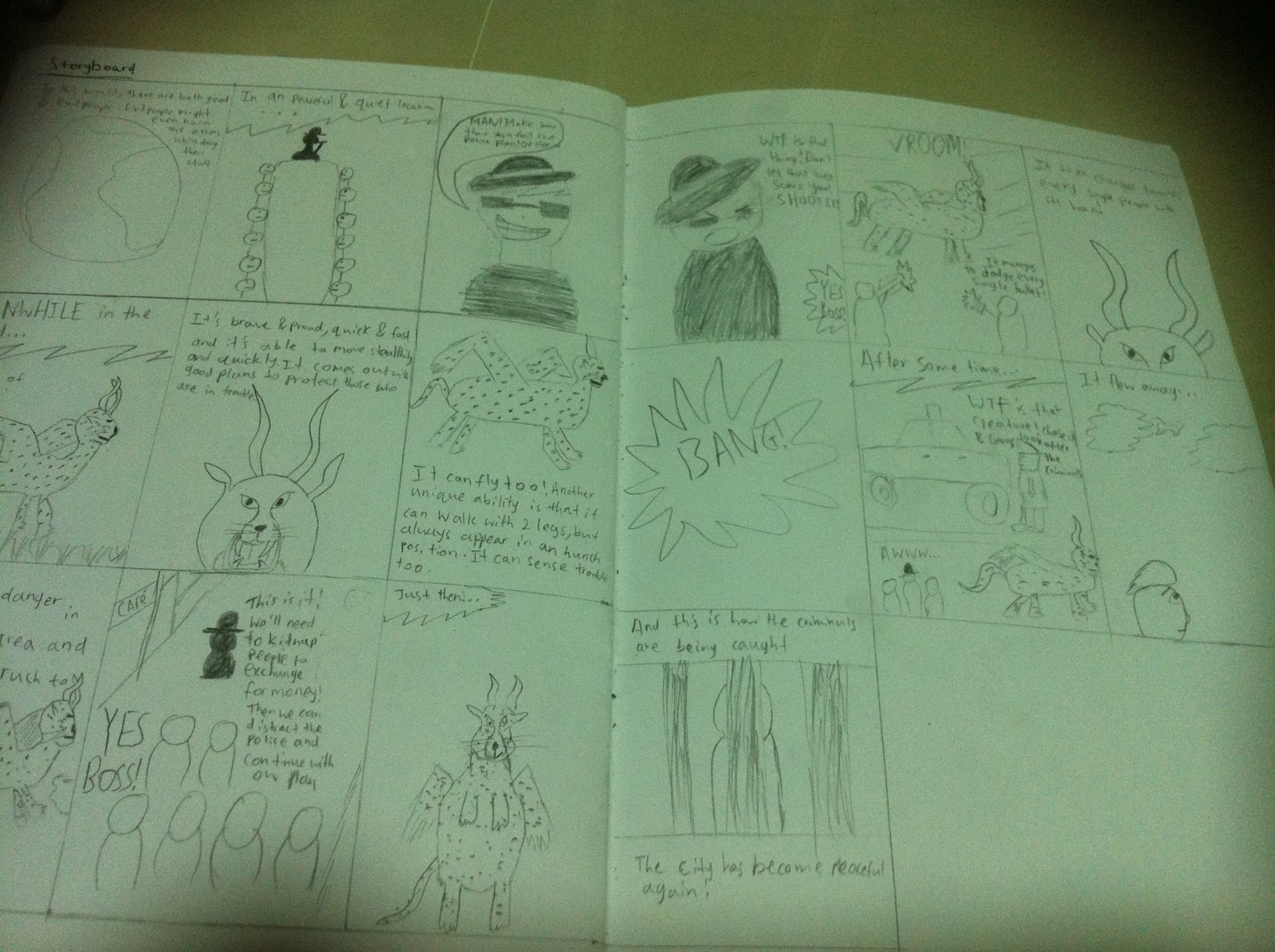
Storyboard

Research 3

Research 4

Research 5
I Think Therefore I Am?
COMMON FOUNDATION - VISUAL ARTS STUDIO
Assignment: Lino Printing
We are to produce a series of lino printing based on the theme itself. That was my first time doing my lino printing, I have never done it before, so the results produced may not be that good. The cutting process was also a tiring one. Below are my documentation of my work.

My Final Print. Looks a lot different from my final sketch eh? Look at the bottom for my final sketch.

First sketch

Second sketch

Third sketch

Fourth sketch

Fifth sketch

Sixth sketch (This is also the concept I've used for my print)
Practice Drawings
COMMON FOUNDATION - BASIC DRAWING CLASS
Practices
Below are some of the drawing/practices completed in the class. First time using charcoal, though. These consists of both still life & life drawings.

Perspectives

Life Drawing 1

Life Drawing 2

Life Drawing 3

Still Life Drawing 1

Still Life Drawing 2
What does the picture tells?
COMMON FOUNDATION - GRAPHIC COMMUNICATION
Right at the bottom are some of the pictures I've taken for my GC assignment. It requires all of us to take a total of 11 pictures, and select one as our best shot. In total, we are to submit 5 colour & 5 Black & White 4R photos, and a 8R/Super 8R photo.

Best Shot


10 Good Shots

Ideally, I should have put this as the best shot instead.
Name Card & Poster
COMMON FOUNDATION - GRAPHIC COMMUNICATION
Assignment: Poster & Name Card Design
As stated above, below is my very own poster and name card design, created using illustrator. This assignment was done during common foundation, which was the period of time before the official start of the games design course itself.

Name Card - Front

Name Card - Back

Event Poster
Subscribe to:
Posts (Atom)